
If you are searching for any EX5 decompiler, you may have an .ex5 file but no longer have access to the original .mq5 source code. You may want to understand how the program works, inspect its structure, recover parts of its logic, or perform authorized technical research.
Before choosing an EX5 decompiler, it is important to understand what an EX5 file actually contains and what can realistically be reconstructed from it.
An EX5 file is the compiled form of an MQL5 program. MetaQuotes documentation explains that developers work with .mq5 source files and compile them into .ex5 executable files that can be used by MetaTrader 5. MQL5 documentation
This means EX5 analysis is not simply a matter of converting one file format into another. It is fundamentally a binary analysis and source reconstruction problem.
What Is an EX5 File?
EX5 is the compiled executable format associated with MQL5 programs used by MetaTrader 5.
The normal development process looks like this:
MQ5 Source Code
      ↓
    Compile
      ↓
EX5 Executable
      ↓
MetaTrader 5
The .mq5 file contains the developer's source code, while the .ex5 file represents the compiled program.
This distinction is important because compilation changes the original source representation. Information such as comments, formatting and some original naming or organizational details may not be directly recoverable from the compiled artifact.
MetaQuotes provides official documentation about the MQL5 compilation process through MetaEditor documentation.
What Is an EX5 Decompiler?
An EX5 decompiler is a software-analysis tool or platform that examines a compiled EX5 artifact and attempts to reconstruct higher-level information about the program.
Depending on the artifact and analysis method, an EX5 analysis workflow may investigate:
Functions and code regions
Control-flow relationships
References
Constants
Strings
Data relationships
Platform interactions
Program structure
Runtime behavior
Candidate source-level logic
The important point is that reconstruction is not necessarily identical to recovering the original source code.
A technically responsible EX5 decompiler should therefore explain what was discovered, what was inferred and where uncertainty remains.
Can You Convert EX5 Back to MQ5?
The short answer is: exact original MQ5 recovery is not guaranteed.
The normal compilation process is:
MQ5 → Compiler → EX5
EX5 reconstruction attempts to reason in the opposite direction:
EX5
 ↓
Binary Evidence
 ↓
Program Structure
 ↓
Logic Analysis
 ↓
Source-Level Reconstruction
The problem is that the compiled artifact does not necessarily preserve every aspect of the developer's original source representation.
For example, an original project may contain:
Comments
Formatting
Developer-selected variable names
Source-file organization
Coding style
Abstractions
Implementation details
Therefore, a reconstructed MQ5-like representation should not automatically be described as the exact original source.
How Does EX5 Decompilation Work?
Professional EX5 analysis can involve several different evidence layers.
1. Artifact Fingerprinting
The first stage is understanding the EX5 artifact itself.
Analysis can consider characteristics such as compiler-related information, build variations, artifact integrity and other properties that may influence subsequent analysis.
This matters because not every EX5 artifact presents the same reconstruction challenge.
2. Structural Analysis
The next step is mapping the accessible structure of the compiled artifact.
This may include identifying:
Candidate functions
References
Call relationships
Control-flow structures
Constants
Strings
Data regions
Platform interactions
A structured representation gives analysts a foundation for understanding how different parts of the program interact.
SnakeDecompiler describes this type of multi-stage workflow through its EX5 analysis pipeline.
3. Control-Flow Analysis
Control-flow analysis examines how execution moves through different parts of a program.
A simplified example is:
Start
  ↓
Condition
 ↙      ↘
Path A  Path B
   \      /
    Continue
This can help analysts understand branches, loops, function relationships and execution paths.
However, reconstructing a high-level if, for or while structure is an interpretation of compiled evidence. It does not necessarily prove that the original developer wrote the source in exactly that form.
4. Data-Flow Analysis
Data-flow analysis focuses on how information moves through the program.
For example:
Input
  ↓
Calculation
  ↓
Transformation
  ↓
Decision
  ↓
Output
Understanding these relationships can help reconstruct the logic of complex MQL5 applications and Expert Advisors.
5. Runtime Observation
Static analysis is not always enough.
Where technically supported and properly authorized, runtime observation can provide additional evidence about how the program behaves when executed.
Static analysis can show what structures are present, while runtime observation can provide information about behavior under particular controlled conditions.
Using both sources of evidence can provide a more complete picture than relying exclusively on one method.
Why AI Alone Is Not Enough
Modern software-analysis systems can use AI to help interpret complicated technical evidence.
AI-assisted reasoning may help identify candidate functions, explain relationships, classify structures or generate possible interpretations of complex logic.
However, AI-generated code can look convincing even when it is incorrect.
That is why AI should be treated as an analysis and reasoning layer, not as unquestionable evidence.
SnakeDecompiler describes AI-assisted reasoning as part of a broader EX5 analysis workflow rather than presenting AI as a standalone solution. More information is available on its AI analysis approach.
The principle is simple:
Evidence should support the reconstruction; AI can help interpret that evidence.
Why Validation Matters
A reconstructed program can appear correct while containing incorrect assumptions.
For example, a decompiler may identify a particular branch and produce readable pseudocode. The output may look reasonable, but additional analysis is required to determine whether the interpretation is actually supported by the available evidence.
A stronger workflow can use:
Control-flow validation
Call-graph consistency checks
Data-flow validation
Type analysis
Cross-analysis comparison
Static and runtime correlation
Repeated analysis
Contradiction detection
Human review
SnakeDecompiler describes a dedicated validation and confidence-scoring process for evaluating reconstructed findings.
This creates an important distinction:
Plausible output is not automatically verified output.
What Factors Affect EX5 Reconstruction?
Results can vary from one EX5 artifact to another.
Important factors may include:
Compiler generation
Build variation
Optimization
Artifact integrity
Program complexity
Protection mechanisms
Available structural evidence
Runtime availability
Supported analysis scope
Because of these variables, claims such as “100% exact EX5-to-MQ5 conversion” should be treated carefully.
A more technically accurate approach is to describe reconstruction according to the evidence available from the individual artifact.
What Should You Look for in an EX5 Decompiler?
If you are evaluating any EX5 decompiler, consider more than whether it produces a source-like file.
Look for:
Evidence-Based Analysis
Does the platform explain how its conclusions are supported?
Structural Reconstruction
Can it analyze functions, references, control flow and data relationships?
Multiple Evidence Sources
Can static findings be supplemented with runtime observations where appropriate?
Validation
Does the system test its own interpretations?
Confidence Scoring
Can you distinguish strong findings from probable or unresolved interpretations?
Transparent Limitations
Does the platform clearly explain what it could not establish?
These characteristics are generally more meaningful than a simple “decompile” button.
When Is EX5 Analysis Useful?
Authorized EX5 analysis can be useful for several professional scenarios.
Legacy Software Maintenance
A business may have an old Expert Advisor but no longer possess the original source project.
Migration Research
Developers may need to understand legacy program behavior before planning a migration or replacement.
Technical Due Diligence
Organizations acquiring software may need to investigate the technical characteristics of compiled assets.
Compatibility Research
Development teams can analyze compiled software as part of controlled compatibility investigations.
Authorized Technical Audits
Software owners or explicitly authorized analysts may need to examine compiled applications for technical purposes.
EX5 analysis should always be performed on software that you own or are explicitly authorized to analyze.
SnakeDecompiler and Evidence-Driven EX5 Reconstruction
SnakeDecompiler positions itself around an evidence-driven approach to EX5 analysis and reconstruction rather than describing the process as a guaranteed one-click conversion.
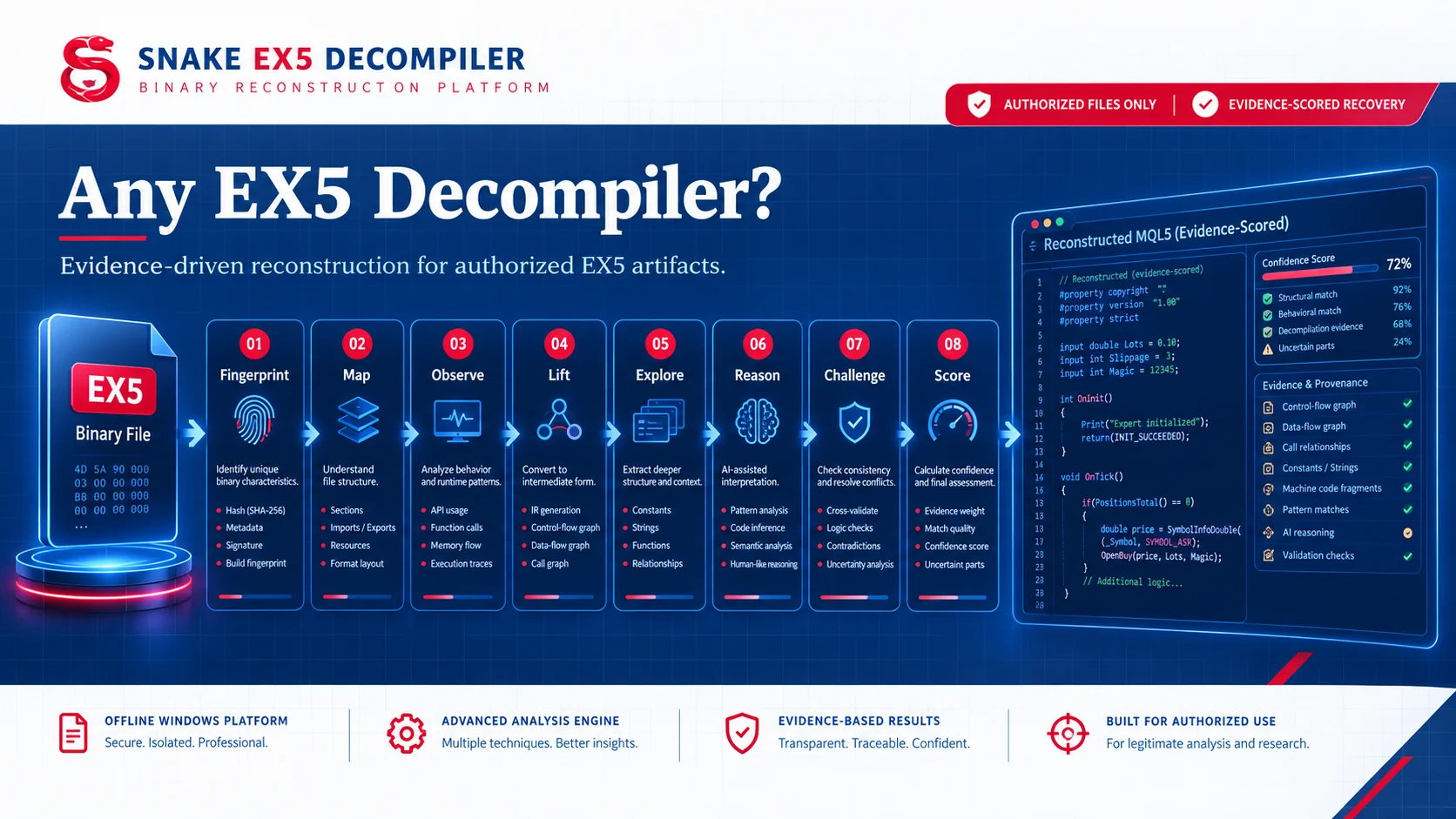
Its published workflow combines multiple stages, including fingerprinting, structural mapping, runtime observation where supported, intermediate representation, candidate exploration, AI-assisted reasoning, contradiction testing and confidence scoring.
You can explore the SnakeDecompiler official website to learn more about its approach.
The objective is not simply to produce code that looks like MQL5. The focus is on connecting reconstructed findings with the evidence supporting them and making uncertainty visible where necessary.
Final Thoughts
If you are searching for any EX5 decompiler, first determine what you actually need from the EX5 file.
If you only need basic information about an artifact, a simple inspection workflow may be enough.
If you need to understand program structure, deeper binary analysis can provide more information.
If you need to investigate behavior, controlled runtime observation may add another layer of evidence.
And if you need source-level reconstruction, you should expect a more complex process involving structural analysis, interpretation and validation.
The most useful question is therefore not simply:
“Can this EX5 decompiler convert EX5 to MQ5?”
Instead, ask:
“What evidence can this system recover from my EX5, how does it reconstruct the program's logic, and how does it validate its findings?”
That perspective provides a more realistic understanding of EX5 decompilation and source reconstruction.
For authorized MetaTrader 5 software analysis, you can learn more about the evidence-driven approach at SnakeDecompiler.
Relatable Sources:
- SnakeDecompiler — Eight-Stage EX5 Evidence Pipeline
SnakeDecompiler Pipeline -
SnakeDecompiler — Validation & Confidence Scoring
SnakeDecompiler Validation -
SnakeDecompiler — Policy-Compliant AI Analysis
SnakeDecompiler AI Analysis -
SnakeDecompiler — EX5 Analysis & Source Reconstruction
SnakeDecompiler EX5 Decompiler