

Any EX4 Decompiler? Complete Guide to EX4 Analysis and Source Reconstruction
If you are searching for “any EX4 decompiler”, you are probably trying to understand, maintain, migrate, audit, or recover information from an EX4 file used by MetaTrader 4.
An EX4 file is the compiled form of an MQL4 program. When the original MQ4 source is unavailable, the compiled EX4 artifact can become the starting point for an authorized technical investigation.
But there is an important distinction between EX4 decompilation and recovering the exact original MQ4 source code.
A compiled binary does not necessarily preserve every source-level detail in a directly recoverable form. Original comments, formatting, developer-selected names, and parts of the original project structure may not be available after compilation.
That is why modern EX4 analysis should focus on evidence-driven reconstruction rather than promising a perfect one-click EX4-to-MQ4 conversion.
What Is an EX4 File?
An EX4 file is a compiled MetaTrader 4 program generated from MQL4 source code.
Depending on the application, an EX4 file may represent an Expert Advisor, custom indicator, script, or library.
The MQ4 file is the developer-oriented source representation, while EX4 is the compiled artifact used by MetaTrader 4.
When the original MQ4 project is lost, an EX4 file may be the only remaining technical artifact available to an authorized developer or software owner.
For broader context, you can explore the SnakeDecompiler platform and its approach to compiled-code analysis.
What Is an EX4 Decompiler?
An EX4 decompiler is a software system designed to analyze a compiled MetaTrader 4 EX4 artifact and reconstruct higher-level information from the available binary evidence.
This can involve:
Bytecode and opcode analysis
Function identification
Control-flow mapping
Data-flow analysis
String and constant recovery
Input parameter analysis
Indicator buffer analysis
Runtime behavior investigation
Source-level reconstruction
However, decompilation should not be viewed as a simple file conversion.
The objective is to understand what the compiled artifact contains and produce a source-level representation supported by the available evidence.
SnakeDecompiler's EX4 Decompiler workflow focuses on structural, data-flow, and behavioral evidence rather than unsupported assumptions.
EX4 Decompilation vs. MQ4 Source Recovery
The terms decompilation and source recovery are often used interchangeably, but they are not necessarily the same thing.
Decompilation transforms information from a compiled representation into a higher-level representation.
Source reconstruction goes further by interpreting recovered structures, relationships, execution paths, and behavioral evidence to create a source-level representation.
For example, the original developer may have used meaningful variable names, comments, formatting conventions, and a specific internal project structure.
Those source-level details may not all survive compilation.
As a result, reconstructed MQ4 should be understood as an engineered reconstruction, not automatically as the author's untouched original source.
What Can an EX4 Decompiler Analyze?
A serious EX4 analysis workflow can examine several layers of evidence.
1. EX4 Artifact Fingerprinting
The process begins with the actual EX4 artifact.
Fingerprinting helps establish relevant characteristics of the file before deeper analysis begins. This can help determine which analysis techniques and tools are technically appropriate for the specific artifact.
2. Bytecode and Structural Analysis
The compiled artifact can be examined for bytecode structures, function boundaries, references, constants, strings, and other identifiable elements.
The purpose is to create a structured understanding of the binary rather than immediately generating source code.
SnakeDecompiler's Reverse-Engineering Arsenal provides additional context on how different analysis capabilities can be orchestrated and cross-checked.
3. Control-Flow Analysis
Control-flow analysis examines how execution can move through the program.
This can help identify:
Conditional branches
Loops
Function relationships
Event handlers
Execution paths
Calls between program components
Understanding these relationships is important when reconstructing higher-level program logic.
4. Data-Flow Analysis
Data-flow analysis examines how values move through the program.
For example, an analysis may investigate how input values are transformed, how calculations are performed, and how those values eventually influence program actions.
This can be particularly useful when investigating indicators, Expert Advisors, calculations, and program logic.
5. Runtime Behavioral Evidence
Static analysis provides one source of evidence.
Where technically supported and appropriately authorized, runtime observation can provide another.
Observed behavior can be compared with static findings to help clarify ambiguous routines and distinguish between competing interpretations.
This is consistent with SnakeDecompiler's broader evidence-driven analysis pipeline, where multiple evidence sources contribute to reconstruction.
Why Validation Matters
A reconstructed code representation can look convincing while still containing incorrect assumptions.
That is why validation is an important part of professional binary reconstruction.
A robust validation process can compare:
Control-flow consistency
Call relationships
Data-flow behavior
Static findings
Runtime observations
Repeated analysis results
Compatibility evidence
SnakeDecompiler's Validation workflow describes multiple validation and consistency checks designed to identify contradictions and unsupported interpretations.
The goal is not simply to produce code that looks plausible. The goal is to determine how strongly the available evidence supports each reconstructed component.
Can an EX4 Decompiler Recover 100% of the Original MQ4?
This is probably the most important question when searching for an EX4 decompiler.
A responsible answer is that no universal guarantee of exact source recovery should be assumed.
The recoverability of an individual EX4 artifact depends on factors such as:
Compiler and build characteristics
Artifact integrity
Program complexity
Available structural evidence
Runtime access
External dependencies
Ambiguous regions
Some elements may be reconstructed with strong evidence, while other areas may remain uncertain.
Claims such as “100% EX4 to MQ4 conversion,” “exact original source guaranteed,” or “perfect recovery from every EX4” should therefore be approached carefully.
The result should instead communicate what was directly observed, what was inferred, and what remains uncertain.
What Can Be Reconstructed From an EX4?
Depending on the artifact, analysis may identify or reconstruct information such as:
Function boundaries
Control-flow relationships
Input parameters
Constants
Strings
Indicator buffers
Mathematical calculations
Program function calls
External dependencies
Observable runtime behavior
Higher-level program logic
However, the level of recoverability can vary significantly from one EX4 file to another.
An evidence-driven approach therefore separates observed evidence, inferred behavior, and the reconstructed representation.
AI-Assisted EX4 Analysis
AI can also be useful as part of a modern binary analysis workflow.
For example, AI can assist with:
Candidate function classification
Cross-function reasoning
Compiler-pattern interpretation
Candidate type inference
Ambiguity detection
Competing-hypothesis generation
Technical explanation
But AI-generated output should not automatically be treated as fact.
A stronger approach is to make AI propose interpretations and then compare those interpretations against binary evidence and deterministic checks.
SnakeDecompiler's AI-assisted analysis follows this principle: AI can assist with interpretation while evidence and validation remain central to the final analysis.
Who Might Need EX4 Analysis?
EX4 analysis can be relevant to legitimate technical scenarios including:
Software owners who have lost their MQ4 source
Developers maintaining legacy MT4 applications
Teams performing migration or compatibility research
Authorized software audits
Technical due diligence
Controlled laboratory analysis
Developers investigating inherited MetaTrader applications
EX4 analysis should only be performed when you own the software or have explicit authorization to inspect it.
For organizations concerned about handling sensitive software artifacts, SnakeDecompiler also provides information about its security and confidentiality approach.
How to Choose an EX4 Decompiler
If you are evaluating an EX4 decompiler, do not focus only on whether it advertises an “EX4 to MQ4” button.
Look for a workflow that explains:
How the EX4 artifact is fingerprinted
How binary structures are analyzed
How control flow is reconstructed
How data flow is tracked
Whether runtime evidence can be incorporated
How AI is used
How contradictions are detected
How results are validated
How uncertainty is represented
What limitations apply to the specific artifact
A multi-stage methodology can provide a more transparent picture of what the technology can actually accomplish.
SnakeDecompiler and EX4 Analysis
SnakeDecompiler positions EX4 reconstruction around an evidence-first binary analysis methodology.
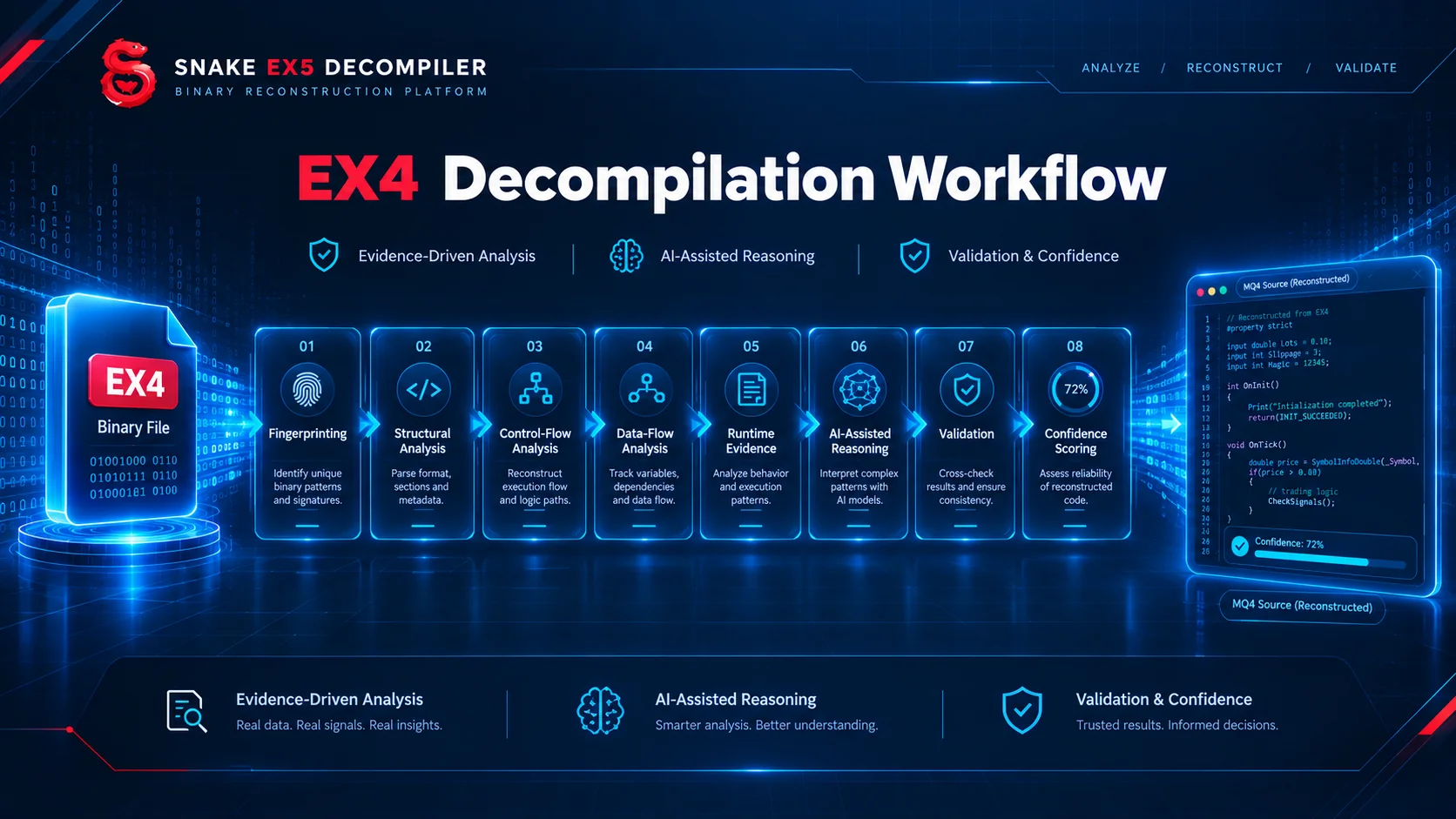
Its approach connects artifact fingerprinting, structural mapping, behavioral evidence, analysis, AI-assisted reasoning, challenge, validation, and confidence scoring.
The platform's broader methodology is explained through its eight-stage analysis pipeline, which is designed to correlate evidence across multiple analysis stages rather than relying on a single interpretation.
The platform also provides a dedicated AI analysis layer and validation system to help distinguish stronger findings from ambiguous ones.
For users evaluating the platform for broader compiled-code workflows, the Reverse-Engineering Arsenal provides additional information about the analysis capabilities involved.
Final Thoughts
So, is there any EX4 decompiler?
EX4 analysis and source reconstruction are technically different from simply converting an EX4 file into the exact original MQ4 project.
A professional approach should start with the compiled artifact, collect structural evidence, analyze control flow and data flow, correlate runtime behavior where available, use AI as an assisting layer, challenge competing interpretations, and validate the resulting findings.
Most importantly, reconstruction should be presented with appropriate confidence rather than as guaranteed perfect source recovery.
For authorized software owners, developers, auditors, and migration teams, an evidence-driven workflow provides a more realistic way to understand what can—and cannot—be recovered from an EX4 artifact.
If your original MQ4 source is missing, the EX4 file can still provide valuable technical evidence. The key is to treat reconstruction as an engineering and validation problem, not as a guaranteed one-click conversion.